Marshes: A Landscape Built by Tides
Tidal salt marshes represent one of the planet's great collaborative architectures between hydrology and flora. They do not merely inhabit a geographical space; the grasses themselves construct, elevate, and stabilize the very terrain beneath them.
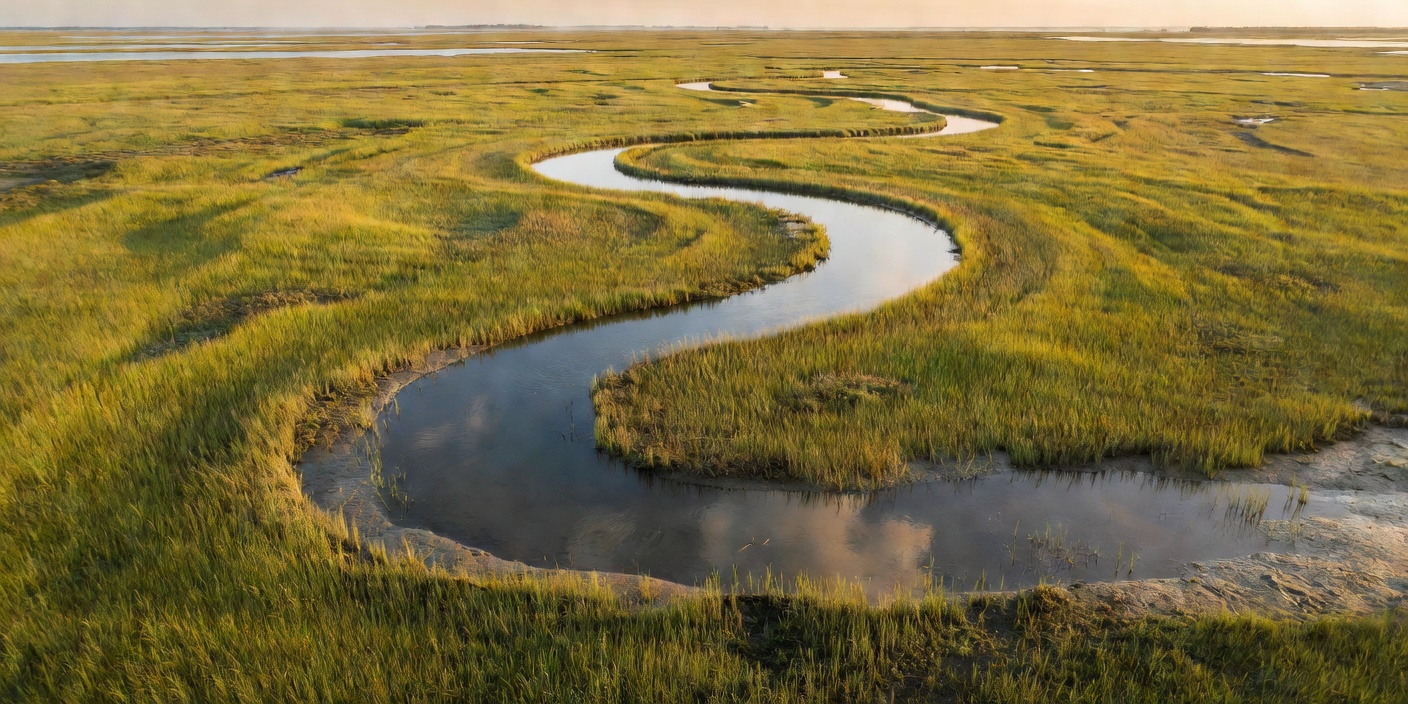
The Architecture of Cordgrass (Spartina)
At the seaward boundary of temperate marshes stands smooth cordgrass (Spartina alterniflora, also classified as Sporobolus alterniflorus). This grass has evolved to withstand high levels of sodium through specialized salt glands and deep aerenchyma tissue—spongy cellular tunnels that pump oxygen from above-water blades down into oxygen-depleted mud roots.
Every incoming flood tide brings suspended sediments eroded from upland rivers or washed in from continental shelves. As water spills over the marsh banks, the stems of cordgrass act as a microscopic forest of vertical friction poles. Water current velocity drops precipitously from meters per second to mere centimeters per second. Deprived of the kinetic energy required to carry silt and clay particles, the sediment drops to the mud floor, blanketing the roots in fresh nutrient-rich mineral layers.
Peat Core Stratigraphy
A core drilled through an ancient salt marsh reveals millennia of stratified history: layers of dark brown fibrous root peat punctuated by grey silt bands left behind by past hurricane surges. Because marsh soils remain permanently saturated with anaerobic saline water, organic matter decomposes at extremely slow rates, locking organic carbon underground indefinitely.
High Marsh vs. Low Marsh Dynamics
The elevation difference between low marsh and high marsh can be as subtle as 15 to 30 centimeters, yet this slight gradient dictates the biological community entirely:
- Low Marsh Zone: Flooded twice daily during regular tides. Dominated almost exclusively by the tall morph of smooth cordgrass. Here, marine worms, ribbed mussels (Geukensia demissa), and juvenile blue crabs navigate the flooded stems during each flood cycle.
- High Marsh Zone: Reached only during extreme spring tides or storm winds. Dominated by saltmeadow cordgrass (Spartina patens), black needlerush (Juncus roemerianus), and spike grass (Distichlis spicata). The fine grasses form swirling, "cow-licked" mats across the plain.
- Tidal Pannes and Salt Flats: Shallow depressions in the high marsh where water collects and evaporates, driving salinity up to over 80 parts per thousand. Only hyper-halophytes like glasswort (Salicornia) can colonize these mineral rims.
Blue Carbon: The Climate Engine in the Mud
While terrestrial rainforests store carbon primarily in living above-ground wood that returns to the atmosphere when trees die or burn, tidal marshes store the majority of their carbon in saturated underground soil matrices.
In salt marsh soils, absence of oxygen prevents aerobic microbes from decomposing organic matter into carbon dioxide. Furthermore, the high salinity suppresses methane-producing archaea, meaning marshes emit negligible quantities of potent methane compared to freshwater bogs. Per square meter, salt marshes sequester carbon up to 40 times faster than undisturbed boreal or temperate forests, making their preservation a foremost priority in climate mitigation strategy.
Follow the Tidal Inundation Basin
Where rivers deliver fresh waters to collide with tidal saltwater.
Explore Estuary Mixing Zones