Mangroves: Life Among Flooded Roots
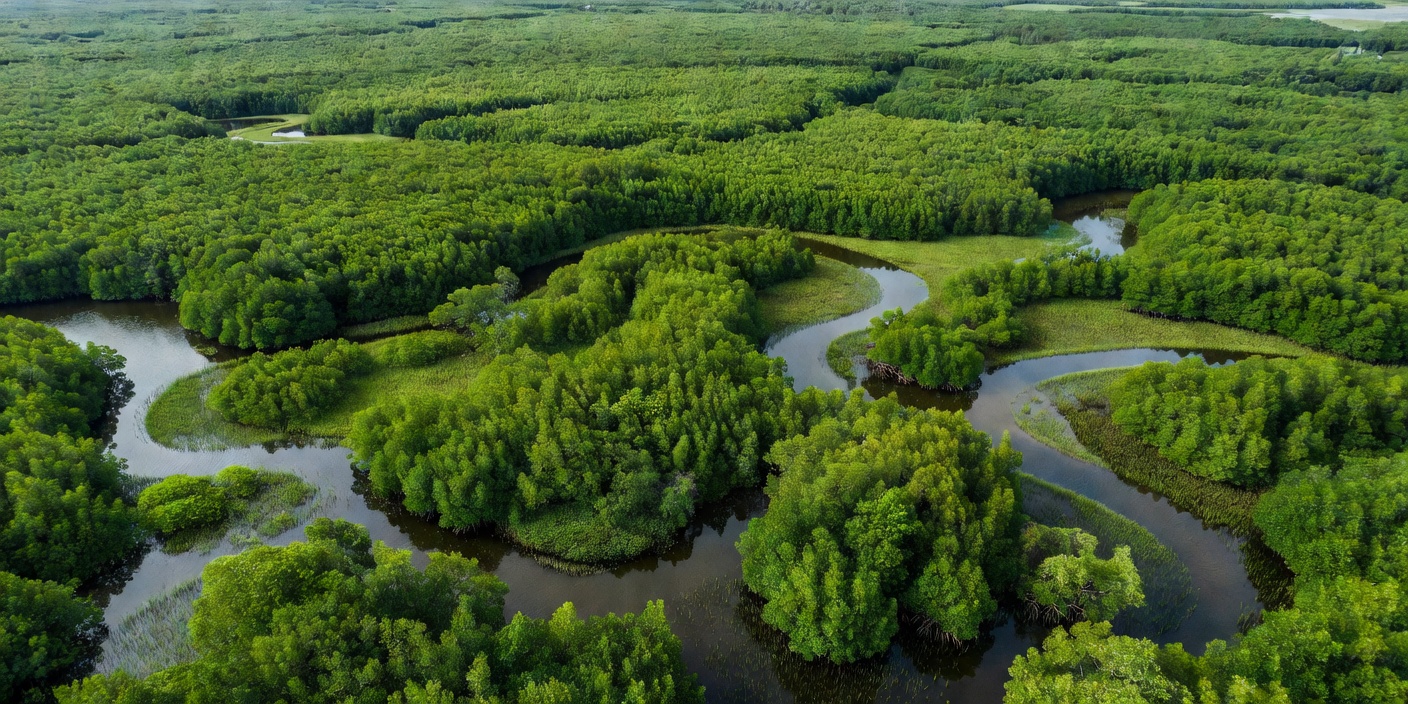
Occupying the dynamic zone between high and low spring tides across tropical and subtropical coastlines, mangrove forests are among the most physiologically resilient plant communities on the planet. They thrive in environments that would rapidly dehydrate or suffocate standard terrestrial flora.
The Extreme Physiology of Halophytes
Mangroves are not a single botanical family; rather, they represent an ecological guild of around 70 recognized plant species from multiple distinct plant families that independently evolved adaptations to withstand extreme salinity, frequent tidal submergence, and anaerobic muddy substrates.
1. Salt Exclusion and Excretion
To maintain cellular homeostasis, mangroves employ two primary biochemical approaches:
- Ultra-filtration at the Root: Species like Rhizophora mangle (Red Mangrove) use heavily suberized cell membranes in their root dermal layers to physically block over 90% to 97% of sodium and chloride ions from ever entering the transpiration stream. Water is drawn in by powerful negative hydrostatic pressure generated in the canopy.
- Glandular Excretion: In contrast, Avicennia germinans (Black Mangrove) absorbs saline fluid but eliminates excess salt through microscopic two-celled foliar salt glands located on the underside of its leaves. Crystallized white salt can be felt and tasted on leaf surfaces during dry daylight hours.
- Sacrificial Accumulation: Certain white mangroves (Laguncularia racemosa) isolate excess sodium into senescent, aged leaves. When these yellowing leaves drop into the water column, the salt load is discarded from the tree entirely.
Field Observation Note
When traversing mangrove fringes during mid-morning low tides, examine the undersides of mature leaves with an 8x hand loupe. You will observe thousands of tiny cubic sodium chloride crystals clustered around glandular pits on Avicennia species, testifying to continuous biological desalination.
Zonation Across the Tidal Gradient
Mangrove forests do not assemble at random. They sort into distinct horizontal bands governed by elevation, the frequency of tidal immersion, soil salinity, and wave exposure. This classic zonation pattern can be seen across the Indo-Pacific and Atlantic-Caribbean basins alike.
| Zone Position | Dominant Genus | Key Adaptation | Ecological Function |
|---|---|---|---|
| Lowest Fringe (Pioneer) | Rhizophora (Red) | High arching stilt prop roots with lenticels | Breaks offshore swell, captures coarse silt |
| Mid-Intertidal Basin | Avicennia (Black) | Thousands of vertical pneumatophores | Pneumatic gas exchange in saturated anaerobic mud |
| High Intertidal Shelf | Laguncularia (White) | Nectar glands at petiole base; shallow peg roots | Transition to terrestrial scrub, ant mutualisms |
| Upland Transition Edge | Conocarpus (Buttonwood) | Standard root system; extreme salt tolerance | Storm surge anchor, terrestrial canopy boundary |
Wave Energy Dissipation & Coastal Defense
The complex, three-dimensional tangle of prop roots, trunk buttresses, and pneumatophores acts as a massive natural baffle. As incoming storm waves enter the fringe, the cross-sectional area through which water can flow is dramatically restricted. Viscous drag against thousands of living timber obstacles strips energy from the wave crests.
Hydrodynamic research shows that within the first 50 meters of healthy red mangrove forest, wave energy drops by up to 50%, and reaches 66% reduction at 100 meters. This friction protects coastal human settlements from catastrophic cyclone swells while allowing delicate fine sediments to settle undisturbed, elevating the forest floor over centuries.
Continue Across the Coastal Transition
Discover how temperate coastal zones replace mangrove forests with expansive cordgrass plains.
Examine Tidal Salt Marshes