Estuaries: Where Waters and Species Meet
An estuary is a partially enclosed coastal body of water where terrestrial freshwater drainage meets open sea saltwater. Within these dynamic mixing zones, temperature, salinity, and dissolved oxygen fluctuate with every turn of the astronomical tide, forming one of the most energetically charged biomes on Earth.
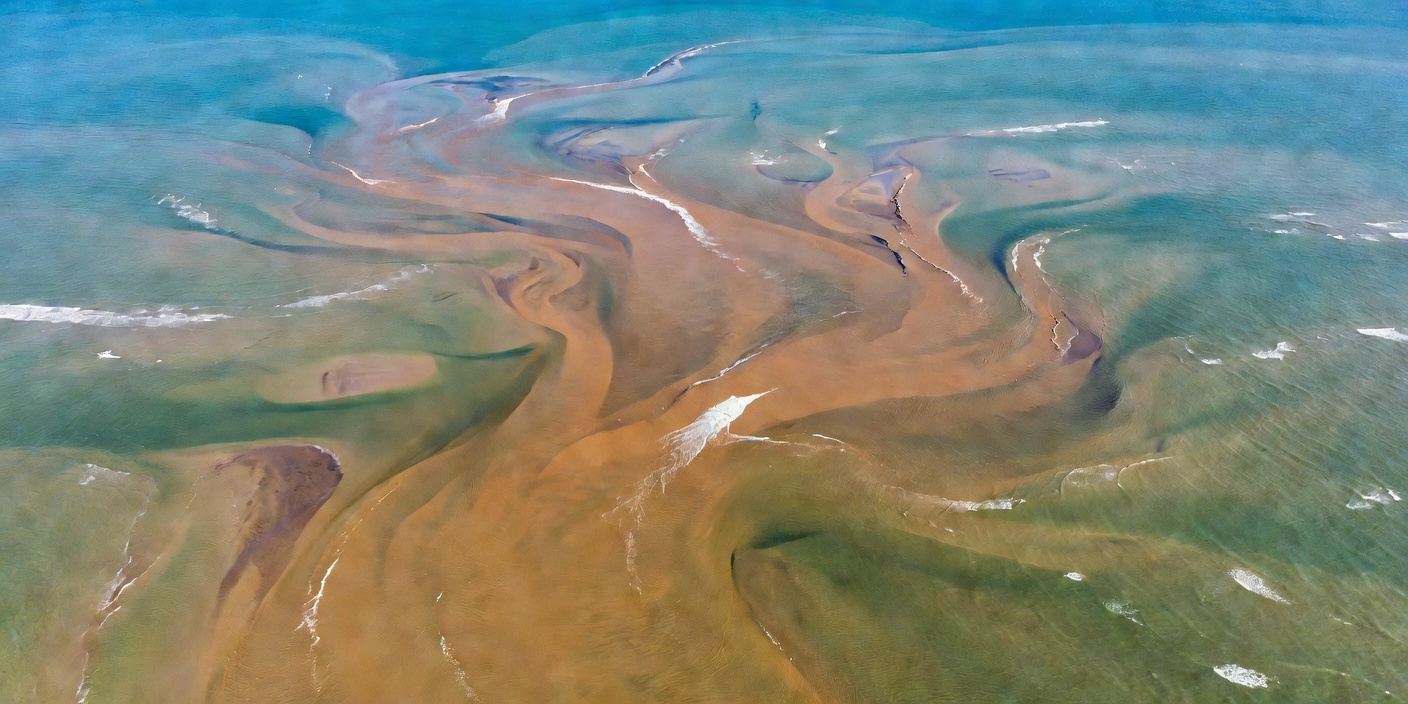
Hydrodynamic Circulation Models
The physics of an estuary dictate its biological capability. Because freshwater is less dense than saline ocean water (which contains roughly 35 grams of dissolved salts per liter), river water tends to ride along the surface, while dense seawater slides underneath along the bed, forming a pronounced salt wedge.
Salt-Wedge Estuaries
Common in high-discharge rivers entering weak tidal basins (e.g., the Mississippi delta). Freshwater rushes seaward over a sharp interface, while a distinct wedge of bottom saltwater creeps upstream beneath it.
Well-Mixed Estuaries
Occur where immense tidal amplitudes overcome river flow, churning the water column through turbulent mixing. Salinity is uniform from surface to bottom but increases gradually as one travels seaward.
The Benthic Engine and Mudflat Ecology
When the tide recedes from an estuary, it leaves behind expansive intertidal mudflats. While appearing barren from a distance, a single square meter of healthy estuary mudflat can contain upwards of 40,000 amphipod crustaceans (such as Corophium volutator) and tens of thousands of polychaete worms (Hediste diversicolor).
These invertebrates graze on microphytobenthos—microscopic diatoms that rise to the mud surface during daytime low tides, forming a golden-brown photosynthetic film that produces vital oxygen and organic carbohydrates.
Avian Feeding Niches along the Mudflat
Notice how multiple shorebird species feed simultaneously across the same muddy bank without resource depletion:
• Pluvers: Visual surface-feeders with short bills that pick active snails and beetles.
• Redshanks: Probe 2–4 cm below mudline for mud shrimps.
• Curlews & Godwits: Insert long, flexible bills 10–18 cm down into deep burrows to grasp lugworms.
Oyster Reefs: Keystone Structural Filters
In temperate and subtropical estuaries, the eastern oyster (Crassostrea virginica) and Pacific oyster (Magallana gigas) build sprawling biogenic reefs. These three-dimensional structures provide hard substrate in an otherwise muddy world, sheltering hundreds of species of blennies, mud crabs, and juvenile reef fishes.
Crucially, a single adult oyster can filter up to 190 liters of water daily, extracting excess phytoplankton, sediment particles, and nitrogen compounds. By clarifying murky waters, oyster reefs allow sunlight to penetrate deep into subtidal zones, fostering lush underwater seagrass beds (Zostera marina).
Protecting the Coastal Connection
Learn how modern conservation frameworks restore fragmented estuaries and degraded wetlands.
Review Wetland Conservation